Stage(d): Rina Banerjee, Chen Wei, Cheng Ran, Su Hang, Ming Wong, ¥ouada, Zai Kuning
Stage(d) brings together artists from diverse cultural backgrounds who approach the world as a constructed stage, where identity, history, desire and belief are continually performed, rehearsed and transformed. The exhibition focuses on moments that are deliberately arranged and repeatedly enacted. Within these staged situations, reality itself becomes subject to presentation and reflection. Through video, photography, painting, works on paper and mixed media, the artists explore how meaning emerges through acts of performance and representation, and how individuals locate themselves within diverse social and cultural contexts.
Act I | Appearance
Cheng Ran (b. 1981, China) introduces key threads concerning the relationship between performance, history and reality. The Lament: Mountain Ghost (2018), inspired by Qu Yuan’s Li Sao, constructs a field suspended between the real and the fictional through a white-painted body, slow ritualised movements, and the interweaving of video and sound. History here is no longer a distant text, but something reactivated through the body and sensory experience, intersecting with contemporary urban life as it is continually “staged”.
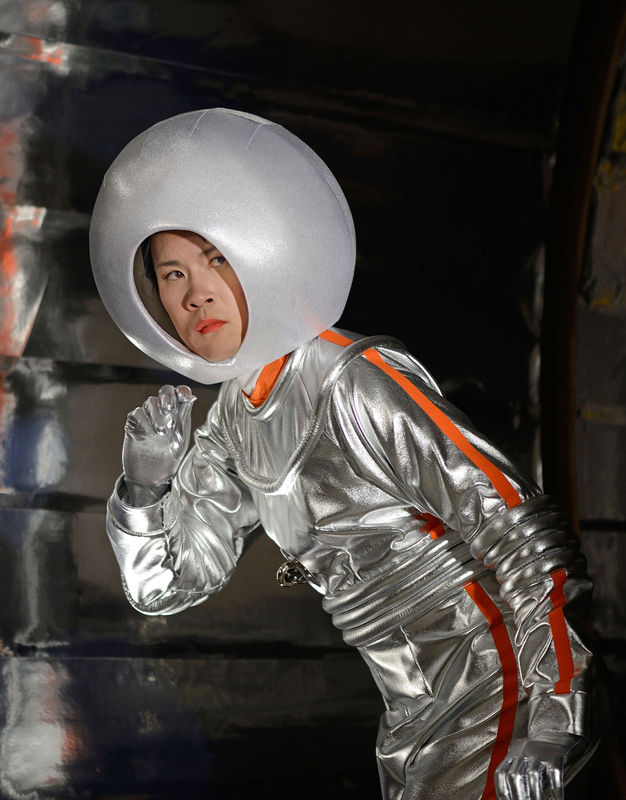
Ming Wong (b. 1971, Singapore) likewise places performance at the centre of his practice, while extending the stage into an imagined space that transcends time and media. In Number 7 from Pictures from the Wayang Spaceship (2022), a Wayang player is inserted into a science-fiction setting, where filters and light produce temporal dislocations. In Astro Girl (2015), Ming appears in a spacesuit, positioned inside a spacecraft as a figure under observation. Within these constructed settings, role and self overlap, presenting identity as something continuously performed and watched.
Act II | Stage on Hold
Shifting away from direct bodily engagement on stage, Su Hang (b. 1996, China) focuses on relationships in which action remains incomplete. Oath (2023) presents a scene of painting under observation: one figure crouches to paint while another stands nearby, watching. The act of painting itself becomes the core of the image. The figures’ postures and the distance between them establish a relationship that feels deliberately set, rendering the scene more like a choreographed arrangement than a naturally occurring moment. Here, painting does not point towards a conclusion, but continues to unfold through the act of viewing, remaining open as an ongoing stage for the viewer.
When action withdraws, the stage nevertheless persists. Chen Wei (b. 1980, China) redirects the notion of the “stage” towards spaces in contemporary society that are arranged yet unoccupied. In the diptych Billiard Ball (2020), an overturned pool table and scattered balls form a carefully staged moment: figures are absent, action is interrupted, yet objects take on narrative weight, suggesting traces of past desires and activities. Within this “paused” scene, everyday space becomes a site for quiet reflection on suspended time, shifting lifestyles and uncertain futures.
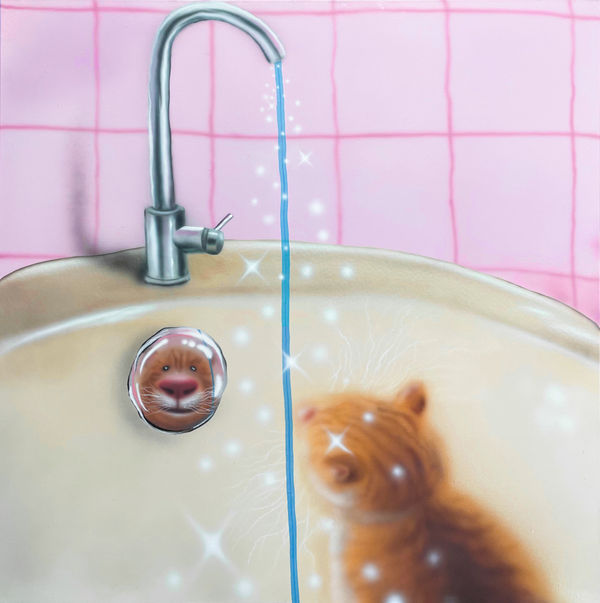
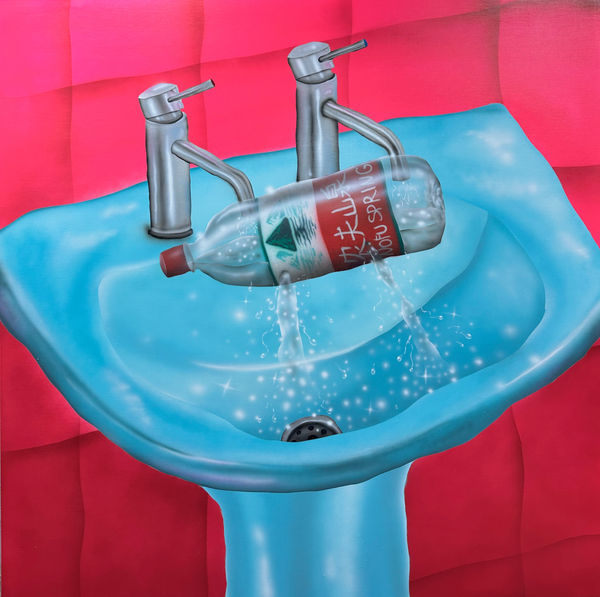
¥ouada (b. 1987, China) dwelves into the intimate sphere of daily life. Bathroom Romance Generator 2 (2025) draws from fragments of lived experience, where a kitten, flowing water and the metallic reflections of the faucet construct a delicately staged viewing scenario. The image does not unfold into a narrative, but lingers in a fleeting moment that invites repeated looking. The sink functions like a temporarily assembled stage, where reflections bring unconscious presences to the perceptual foreground. In this suspended scene, emotion does not arise from the event itself, but gradually emerges through the act of looking.
Act III | Awakened Site
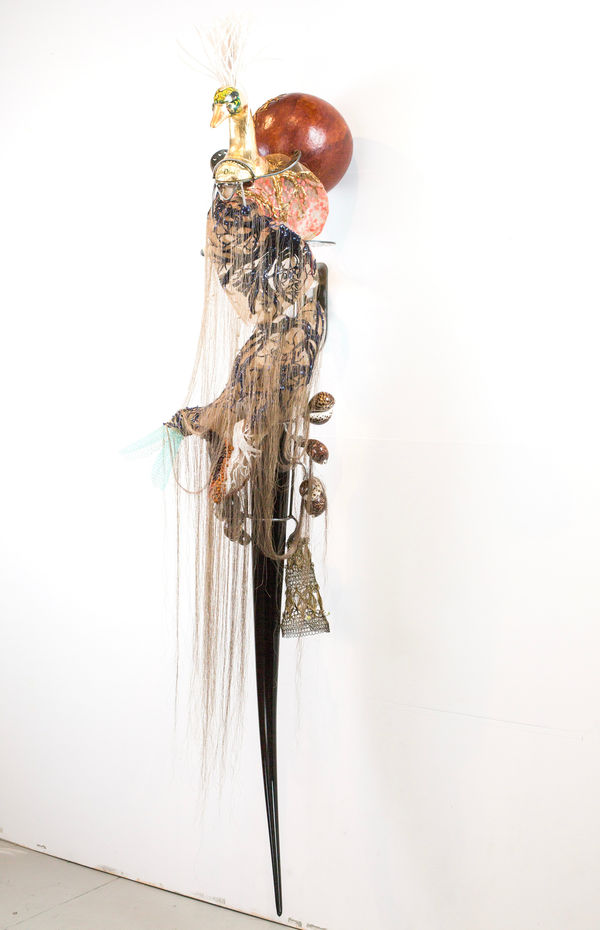
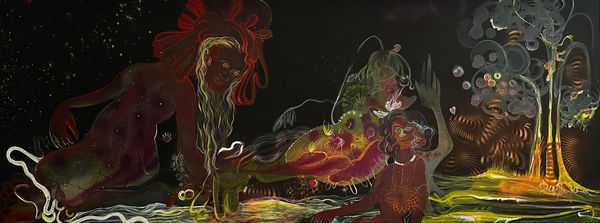
Rina Banerjee (b. 1963, India) extends the stage into the realm of myth and fantasy. In Like a circus of strings smoke… (2025), the dark background resembles a theatrical black box, against which female figures appear in exaggerated, suspended poses. They are visible to one another, yet do not unfold a linear narrative. This method of arrangement and presentation continues in her wall-mounted sculptures. In See her beak… (2017), materials and cultural references from diverse origins are assembled to construct the attire and body of a fictional creature, allowing it to step out of the image and occupy the viewer’s physical space.
Zai Kuning (b. 1964, Singapore) moves further away from figuration, shifting the stage towards a perceptual field shaped by colour, material and memory. His long-term engagement with indigenous communities such as the Orang Laut and Orang Asli informs a pictorial language centred on perception and memory rather than narrative imagery. Natural materials such as turmeric, chilli powder and traditional batik dyes enable the colours themselves to convey scent, tactility and cultural memory. Abstract forms no longer denote specific objects, but instead evoke a field that may be entered and experienced.
In the exhibition Stage(d), the stage is neither metaphor nor backdrop, but a way of revealing how reality is arranged, presented and continually set into motion. When bodies withdraw, actions pause and images dissolve, the stage does not disappear—it shifts into the reality occupied by the viewer. Ota Fine Arts Shanghai invites you to step into the exhibition space, enter this ongoing site, and to become a part of the stage, through the act of looking.
-
 Chen WeiBilliard Ball, 2020Archival Inkjet Print80 x 64 (each) x 2 panels
 -
Chen WeiIn the Waves #5, 2013Archival Inkjet Print150 x 187.5 cm
-
Cheng RanThe Lament: Mountain Ghost, 2018Single channel video with sound13’14”
-
Ming WongNumber 7 from Pictures from the Wayang Spaceship, 2022Archival digital print170 x 86 cm
-
Ming WongAstro Girl I, 2015Archival digital print76 x 60 cm
-
Zai KuningSecrecy of Plant in Darkness 6, 2023Batik dye, chilli powder, pencil and ink on paper59.2 x 43.7 cm
-
¥ouadaBathroom Romance Generator 2, 2025Acrylic on canvas120 x 120 cm
-
¥ouada2 into 1 then 1 into 2, 2024Acrylic on canvas150 x 150 cm
-
Rina BanerjeeSee her beak a coppery bill, her pointed puncture with black horn waiting in edges of river among stones and ocean pearls, her coarse curls sleeps outside of home, outside of culture, in open air, feel her tire without tone of muscle in effortless slumber, 2017Glass, steel, silk, ceramic, plastic net, shells195 x 55 x 43 cm
-
Rina BanerjeeLike a circus of strings smoke made into lace mother hand,like natures song gifted fortune and finger limber made him magic and wonderous in cloth then to wonder who he could be?, 2025Acrylic on canvas91.5 x 244 cm