Take Me Home!!

Ota Fine Arts Singapore is pleased to present “Take Me Home!!”, a group exhibition featuring works by nine artists: Mannat Gandotra, Masanori Handa, Hilmi Johandi, Zai Kuning, Yayoi Kusama, Atreyu Moniaga, Soe Yu Nwe, Nobuaki Takekawa and Guo-Liang Tan. This exhibition revisits the simple yet meaningful act of bringing an artwork into one’s home by offering a diverse and playful selection of small to mid-sized pieces, spanning from the figurative to the abstract, from monochrome palettes to psychedelic hues, and with mediums ranging from acrylic on canvas to stone and beeswax. The works presented are an extension of the artists’ ongoing practices and offer the core of their artistic expressions in a more intimate and approachable form. Accessible in both scale and price point, “Take Me Home!!” offers an inviting entry point for new collectors while presenting opportunities for seasoned collectors to acquire works that remain deeply representative of each artist’s practice.
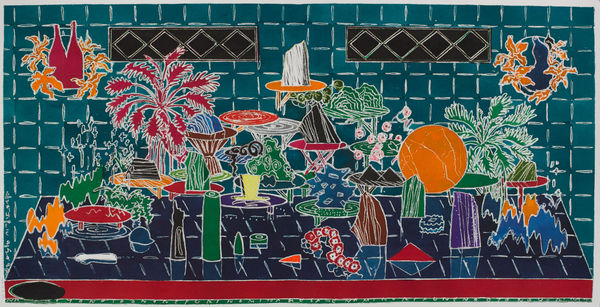
singapore no nakakiyo (2016) by Masanori Handa illustrates the artist's installation work nakakiyono entakukei, which was first presented in Singapore in 2013. Inspired by a traditional Japanese poem known for its expression of a long, humid night, the installation is an immense and intricate site-specific piece put together with an assortment of ready-made materials. Drawing from Singapore’s landscape, Handa envisioned the piece as a low-lying delta, patterned by meandering rivers and streams, and constructed it with circular tables and littered with ordinary objects found locally. The rich and bold watercolour on paper piece presents a striking, surreal vision of imagined sceneries.
Hilmi Johandi presents a series of small paintings titled Placemaking (2023), exploring the construction of imagined spaces that are rooted in realities. These multi-layered paintings challenge the spatial orientation that is integral in the everyday existence of architecture, where walls determine the flow and function of the space – their fragmented constructions allow the audience to lose their orientation and enter new spatial experiences within the paintings.
A series of small works on paper by Zai Kuning spreads across the gallery wall. Inspired by his engagement with the Orang Laut community, nomadic indigenous fishermen living in the Riau archipelago, Zai used natural pigments such as turmeric, chilli powder, and traditional batik dye to create abstract forms that resonate and echo with voices, memories, and the Orang Laut’s way of life.
Meanwhile, Nobuaki Takekawa approaches the past through storytelling and allegory. Cat’s Mine Labour Hanafuda (2025), a series of woodcut prints inspired by Hanafuda playing cards, presents a charming world of feline miners that belies its historical matter. Through these playful yet poignant scenes, Takekawa traces the buried history of the Ashio Copper Mine, a cornerstone of Japan’s Industrial Revolution whose social and environmental repercussions continue to resonate in today’s modern world. By employing cat motifs, Takekawa approaches these historical and social issues in an objective and nuanced manner.
In contrast, Ripples (1979) by Yayoi Kusama offers a quieter and more understated presence. The work is an extension of the "infinity nets" motif that Kusama has become known for, beginning in the late 1950s and continuing throughout her practice till today. Through dense accumulations and rhythmic repetition in enamel spray paint, Ripples invites a slower, more sustained form of looking, where notions of infinity emerge through repetition, silence, and persistence.
Guo-Liang Tan utilizes aeronautical fabric – a translucent, water-resistant synthetic polyester textile – in his work. Sand Drift (2024) was created by layering transparent colours of diluted acrylic paint atop the water-resistant surface. Unlike conventional painting, which uses a brush for direct mark-making, Tan’s work comprises stains and traces made indirectly by the pooling of paint and by placing objects on the horizontal ground to create imprints. The shadowy presence of the wooden stretcher beneath can be observed through the translucent ground, revealing the work’s structure and adding another layer to its visual plane.
On the other hand, Mannat Gandotra’s paintings exude an intense energy through her dynamic compositional structures of line, colour and form. In Submerged Paragraph (2025), Gandotra approaches the work as a process of creating problems and trying to resolve them in an ever-expanding space. Lines are sometimes straight, curved or fractured, and colours go next to each other in unusual combinations; elements clash and bounce off one another, and yet sit together in a dissonant atmosphere.
Soe Yu Nwe’s ceramic sculptures draws inspiration from Burmese folklore, vernacular arts, and Buddhist and animistic practices. Her sculptures often feature fragmented female bodies transformed into visceral, semi-botanical forms. The “Goddess of the Serpent” and the head of Guanyin (Goddess of Mercy) are recurring mythical motifs portrayed in her works, often metaphors for the self, rebirth and femininity -- a symbolic challenge to the conservative gender roles traditionally upheld in Myanmar’s Buddhist doctrine. Deeply intertwined with cultural and mythological notions of beauty, Nwe’s intricate sculptures invite us to re-examine our perspectives on the world.
Themes of transformation continue in the works of Atreyu Moniaga, whose paintings embody the fantasies and anxieties of a younger urban generation. His otherworldly compositions reveal a whimsical universe of mystical creatures, ornamental plants, and spirited characters that one may associate with animation films. Brimming with vivid colours and intricate details, the figures in his works are often surrounded by lush, surreal landscapes, reflecting the unpredictability and chaotic journey of personal growth. These motifs also mirror the emotional turbulence of personal growth, capturing the conflicting emotions of restlessness, resilience, fear, courage, exhilaration and uncertainty.
Through a thoughtfully curated selection of works at accessible price points, “Take Me Home!!” highlights the richness and diversity of contemporary Asian art which extends across geographies, histories, identities and social situations. Ota Fine Arts Singapore invites both seasoned and first-time collectors to experience the pleasure of looking and to explore how art can transform everyday spaces and foster personal connections, by simply bringing them home.
-
 Guo-Liang TanSand Drift, 2024Acrylic on aeronautical fabric, wood120 x 96.5 cm
 -
Nobuaki TakekawaCat’s Mine Labour Hanafuda - Pollution (1), 2025Acrylic on woodcut print65 x 45 cm
-
Nobuaki TakekawaCat’s Mine Labour Hanafuda - Break Time (1), 2025Acrylic on woodcut print65 x 45 cm
-
Nobuaki TakekawaCat’s Mine Labour Hanafuda - Minecart (4), 2025Acrylic on woodcut print65 x 45 cm
-
Nobuaki TakekawaCat’s Mine Labour Hanafuda - Resistance (3), 2025Acrylic on woodcut print65 x 45 cm
-
Soe Yu NweSnake Fruit #2, 2025Woodfired ceramics, epoxy23.5 x 18 x 11 cm
-
Soe Yu NweKannon x Guanyin x Eye, 2025Woodfired ceramics, found glass, epoxy13.5 x 16 x 26 cm
-
Soe Yu NweNuwa Intimated 1, 2025Wood fired stoneware14 x 27 x 16 cm
-
Zai KuningMoving Tomb 3, 2025Stones, wax, string, boneH18 x 15.5 x 14 cm
-
Zai KuningEverywhere is a place of worship, 2025Stone, wax, stringH29 x 17 x 13 cm
-
Zai KuningUntitled, 2023Batik dye, turmeric and pencil on paper29.6 x 24.4 cm
-
Zai KuningUntitled, 2023Batik dye, chilli powder and acrylic on paper40.7 x 28. 3 cm
-
Zai KuningUntitled, 2023Batik dye, chilli powder and acrylic on paper40.3 x 39.9 cm
-
Hilmi JohandiStagecraft: Sentosa Island, 2022Emulsion and acrylic paint on wood, sandbags, wooden stretcher frame140 (h) x 219 x 58 cm, 65 x 60 cm
-
Hilmi JohandiPlacemaking #1, 2023Oil on linen50.3 x 65.3 cm
-
Hilmi JohandiPlacemaking #2, 2023Oil on linen50.5 x 30.5 cm
-
Hilmi JohandiPlacemaking #3 , 2023Oil on linen66.3 x 76.2 cm
-
Atreyu MoniagaEAGLE EYED ANGEL, 2024Acrylic on linen70 x 90 cm
-
Atreyu MoniagaTHE CORONATION, 2024Acrylic on linen120 x 90 cm
-
Masanori Handasingapore no nakakiyo, 2016Watercolour, oil pastel on paper77 x 149 cm