Selfless Devotion|Loving Care: Yoshiko Shimada

The gallery will be closed on the following dates during the Golden Week period, in addition to our regular closure days on Sundays and Mondays:
April 29 (Wed), May 5 (Tue), and May 6 (Wed)The gallery will be open as usual on all other days.
Ota Fine Arts is pleased to present the solo exhibition “Selfless Devotion / Loving Care” by Yoshiko Shimada. This exhibition features the works in the series Past Imperfect, created by Shimada during the period after the end of the Showa era (1998) and the 50th anniversary of the end of the Second World War (1995). The works explore the willing participation of Japanese women in the war— subjects previously addressed only as “victims of war.”
After the subsequent “Lost 30 Years” and age of neoliberalism, Shimada re-examines the complex relation of women and nation through these works and wartime national policy slogans. What is women's “social participation”? What is “self-realization”? In Japan where these concepts have been rephrased as “women's empowerment” under advanced capitalism, where do we stand now?
The exhibition titles “Selfless Devotion” and “Loving Care” were phrases that frequently appeared in wartime slogans. These keywords—evoking femininity and motherhood—were embodied by wartime “women's associations” tasked with safeguarding the home front. Among them, the National Defense Women's Association grew into a massive organization of 10 million members. These women carried out their duties clad in their “uniform” of white aprons and sashes. Often depicted as an army devoid of individual will, yet numerous memoirs exist where women—deprived of suffrage, confined to the home, and unable to claim personal time—found liberation and exhilaration in donning the same uniform regardless of social status, enabling “social participation” through national contribution. Women's “self-realization” through “self-sacrifice for the public good” converged into identification with the state.
While their activities included seeing off soldiers to war, women's primary tasks consisted of reproductive work—housework, childcare, caregiving, managing the health and physical fitness of family members, but most crucial was reproduction as “breeding machines.” This “private labor” of childbearing and rearing was elevated to “social labor” with the state's official endorsement. Similarly, performing “loving care” with a smile (feminine charm!) was also required of women as social labor. The objects of this care extended beyond children and animals to encompass all public things: rivers, roads, trees and colonies. Ultimately, however, the objects of care were sacrificed to the state. Children, nurtured with love, were forced to fight to the death to defend the nation. Dogs, horses, and colonial subjects had their lives taken, and the homeland was devastated.
Over 80 years ago, women inspired by slogans like “selfless devotion” and “loving care” were ultimately “human resources” conveniently exploited by the state. Does this sound like ancient history? In contemporary Japan, there is a growing tendency to praise women who abandon work-life balance, selflessly work, work, work, work, work. At the same time, being a housewife, devoting oneself to childcare and homemaking is encouraged as “a woman's career choice.” But even the winners of neoliberalism, women who achieve self-realization through personal qualities and effort, are in fact convenient and efficient “human resources” capable of both productive and reproductive labor. The state still manages and utilizes women, just as during the wartime. We hope this exhibition provides an opportunity to reflect on the relationship between the state and women.
-
 Yoshiko ShimadaTied to Apron Strings, 199312 white aprons, waist-cords for Kimono, toy pistols, photocopy of war dead, the Imperial Rescript to Soldiers and Sailors
 -
Yoshiko Shimada1000 Red Knots, 1993Collage on canvas, threadSet of 4: 33 x 24.2 cm each
-
Yoshiko ShimadaBaby Contest, 1992Etching39.5 x 56.3 cm (image)
50.1 x 69.6 cm (paper) -
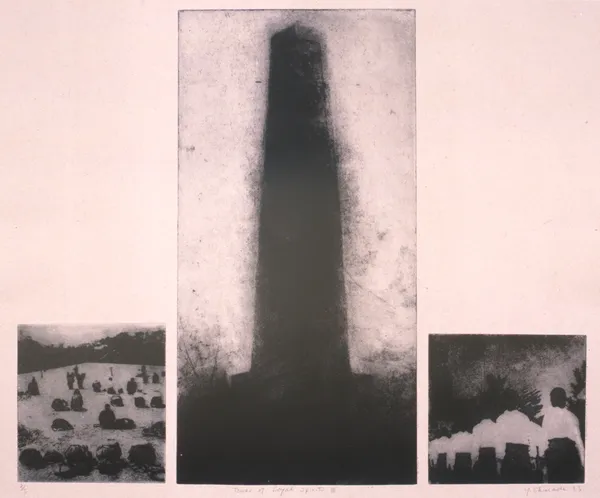
Yoshiko ShimadaTower of Loyal Spirit Ⅲ, 1995Etching49.6 x 59.5 cm
-
Yoshiko ShimadaShooting Lesson, 1992Etching44.8 x 60 cm (image size)
-
Yoshiko ShimadaA Woman Shooting II, 1992Etching45.3 x 69.5 cm (image size)
-
Yoshiko ShimadaA House of Comfort, 1993Etching59.8 x 39.8 cm (image)
-
Yoshiko ShimadaExercise, 1995Etching39 x 56.2 cm (image)
50 x 70 cm (paper) -
Yoshiko ShimadaMother and Child, 1993Etching59.7 x 39.7 cm (image)